
The Australian Signals Directorate (ASD) received over 36,700 calls to its Cyber Security Hotline—an increase of 12% compared to the previous year. According to the ASD, the average cost of a cyber breach is approximately $46,000 for small businesses and around $97,200 for medium-sized businesses in Australia.
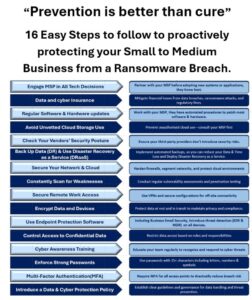
While cyber insurance may help cover some of these financial losses, the productivity disruption, customer dissatisfaction, and reputational damage that follow are consequences no business can afford to ignore.
If you’re a business owner, take just 5 to 10 minutes to review the write-up below. Work openly with your Managed Services Provider to assess your current risk posture and take proactive steps to secure your business. Don’t wait until it’s too late—let’s get your house in order now.
A Data & Cyber Protection Policy is essential for small to medium businesses (SMBs) to safeguard their operations, reputation, and customer trust. As cyber threats grow in frequency and sophistication, SMBs are increasingly targeted due to often having weaker security controls. As many of you believe, because you have a small business you are not a target, the ‘Bad Actors Don’t Care’. So, a well-defined policy, created in partnership with a knowledgeable Managed Services Provider (MSP), helps establish clear standards for data handling, threat prevention, incident response, and employee responsibilities. MSPs bring specialised expertise in compliance, risk mitigation, and industry best practices, ensuring the policy is practical, up-to-date, and tailored to the business’s size and needs. This collaboration helps identify vulnerabilities, implement appropriate controls, and train staff effectively, reducing the likelihood and impact of breaches. Moreover, it demonstrates a proactive commitment to data protection, which can enhance trust with clients, partners, and insurers. In the event of an incident, a documented policy provides a structured response plan, minimizing downtime and financial loss. By leveraging an MSP’s knowledge, SMBs gain enterprise-level protection without the overhead, enabling them to stay focused on growth while maintaining resilience in a volatile threat landscape. A strong Data & Cyber Protection Policy isn’t just IT hygiene, compliance, or a checklist > it’s a critical business asset.
Enabling Multi-Factor Authentication (MFA) is a critical security measure for businesses, significantly reducing the risk of unauthorised access. Many ransomware attacks exploit stolen or weak credentials—something MFA can effectively block. A stark example is the 2021 Colonial Pipeline ransomware breach, where attackers accessed the network via a compromised VPN account without MFA, leading to fuel shortages across the U.S. east coast (CISA, 2021). By adding a second layer of verification, MFA is a layer of protection, even if passwords are compromised. It’s a low-cost, high-impact defence that strengthens secure access and improves your cybersecurity posture. Next let’s discuss the value of a strong password.
Using strong 15-character alphanumeric passwords with symbols this greatly reduces the risk of brute-force attacks. The 2019 Norsk Hydro ransomware attack, partly due to weak credentials, cost the company over $60 million (Reuters, 2019). SMBs, strong passwords are a simple, effective defense against costly breaches. According to Hive Systems, when you adopt our suggestion, it will take a over 77 million years to crack in to your system.
Encrypting devices and restricting access to sensitive data are vital steps in protecting business information from loss, theft, or unauthorized access. For small to medium businesses, these practices ensure that even if a device is lost or stolen, the data remains unreadable to outsiders. A Managed Services Provider (MSP) can help implement encryption across all endpoints, configure access controls based on roles, and monitor for unauthorised activity. MSPs also assist in identifying what data is sensitive, where it resides, and who truly needs access. This partnership strengthens data security, reduces regulatory risks, and helps business owners maintain control and compliance with ease.
Unpatched devices expose businesses to known vulnerabilities, making them prime targets for ransomware. The 2017 WannaCry attack exploited outdated Windows systems, crippling thousands of organizations globally. Similarly, the 2021 Kaseya breach affected hundreds of MSP clients through unpatched software. While Endpoint Detection and Response (EDR) tools provide defense, they react after threats emerge. Proactive Managed Detection and Response (MDR) adds real-time monitoring, threat hunting, and faster remediation. A trusted Managed Services Provider (MSP) ensures patches are applied promptly, MDR and EDR tools are integrated, and threats are contained early. With an MSP, businesses gain expert oversight to close gaps before attackers exploit them.
Securing remote and hybrid team members is essential in preventing ransomware breaches, as dispersed workforces often operate outside traditional network defenses. Without proper controls, unsecured home networks, personal devices, and weak access practices become easy entry points for attackers. Hardening the network and cloud environments—through VPNs, endpoint protection, access controls, and cloud security configurations—reduces these vulnerabilities. The 2020 ransomware attack on Blackbaud stemmed from a compromised remote access point, affecting multiple clients and costing millions. With robust remote security and hardened environments, businesses reduce risk exposure and ensure consistent protection, regardless of where employees work—critical for maintaining business continuity and trust.
Deploying security tools alone isn’t enough—cybercriminals are constantly evolving. Smart attackers find new ways to exploit overlooked gaps. That’s why continuous monitoring, scanning, and process-driven oversight are critical. A Managed Services Provider (MSP) excels here—it’s their bread and butter—to detect, respond, and stay ahead of threats in real time.
Backup is a fundamental component of disaster recovery, with local retention enabling fast restores and offsite backups providing protection against site-wide failures. Key to evaluating a backup strategy is the Recovery Point Objective (RPO)> how much data loss is acceptable, and the Recovery Time Objective (RTO) > how quickly systems must be restored. For small to medium-sized businesses (SMBs), Disaster Recovery as a Service (DRaaS) offers a cost-effective solution that ensures business continuity. It provides enterprise-grade replication, rapid failover, and expert support without requiring heavy infrastructure investment. DRaaS helps SMBs meet strict RPO/RTO targets, minimize downtime, and maintain operations even during catastrophic events.
Vetting the security practices of vendors and third-party SaaS providers is crucial for safeguarding your business. These integrations can serve as entry points for cyber threats, especially ransomware. In 2024, the average cost of a ransomware attack was $1.85 million, with breaches in the banking sector averaging $6.08 million per incident. The 2025 attack on Marks & Spencer, attributed to Scattered Spider, led to over £1.2 billion in losses and significant reputational damage. Similarly, UnitedHealth’s breach in 2024 compromised 190 million records, costing an estimated $1.6 billion. These incidents highlight the importance of assessing third-party security measures, including data encryption, access controls, and compliance with industry standards. Implementing a robust vendor risk management program can mitigate potential threats, ensuring business continuity and protecting sensitive data.
Storing business data in the cloud without consulting IT management exposes organizations to significant security risks. Without proper oversight, sensitive information may be stored in misconfigured cloud environments, making it vulnerable to unauthorized access. For instance, in 2019, a misconfigured web application firewall in Capital One’s AWS cloud environment compromised the personal information of over 100 million customers. Similarly, in 2022, Sequoia, an HR and payroll services company, disclosed a data breach due to unauthorized access to a cloud storage repository, exposing sensitive personal data. These incidents highlight the importance of involving IT management in cloud data storage decisions to ensure proper configuration, access controls, and compliance with security standards.
Data and cyber insurance are a critical safeguard in today’s threat landscape, helping businesses mitigate financial losses from data breaches, ransomware attacks, and regulatory fines. It covers expenses such as data recovery, legal fees, business interruption, and customer notification costs. MSPs play a vital role in helping businesses meet the security and compliance requirements that insurers demand, including regular audits, patch management, access controls, and data encryption. They ensure policies align with frameworks like Essential8, GDPR, HIPAA, or ISO 27001, reducing both risk and premiums. With cyber threats constantly evolving, MSPs provide ongoing security assessments and incident response planning, which strengthens a company’s insurability and resilience. By combining cyber insurance with expert MSP oversight, businesses gain a comprehensive safety net—balancing prevention with protection—and ensuring operations continue smoothly even in the face of a cyber incident.
In today’s ransomware-ridden landscape, small to medium businesses face growing threats that can cripple operations and devastate reputations. A Managed Services Partner (MSP) provides critical protection through continuous monitoring, proactive patching, data backup, and robust cybersecurity strategies tailored to your business. MSPs help you stay ahead of cybercriminals with advanced threat detection and rapid incident response—resources most SMBs can’t manage alone. With regulatory pressures and evolving attack methods, safeguarding your IT isn’t optional—it’s essential. Don’t wait for a breach to expose your vulnerabilities. Connect with me for a Cyber & Data Protection Discovery chat, I will introduce you to a very reliable MSP, who can identify and risks and will know how to fix it too.


